OFFICE FOR CLIMATE CHANGE AND SUSTAINABILITY
Knowledge-based institutional
response to systemic
sustainability challenges.
Strategic Areas

EDUCATION

RESEARCH

OPERATIONS

Climate action and decarbonisation

Climate resilience and adaptation

Resource management and the circular economy

Water protection and sustainable natural resource management

Pollution reduction and improved environmental quality

Biodiversity protection and the development of sustainable communities
Climate Action and Decarbonisation
Reducing emissions and supporting the transition towards low-carbon and climate-neutral systems
This area covers:
- greenhouse gas emissions inventories and carbon footprint assessments, including Scope 1, 2 and 3 emissions;
- decarbonisation strategies, transition plans and roadmaps to net zero emissions;
- energy efficiency, renewable energy and sustainable buildings;
- sustainable mobility and transport decarbonisation;
- a just transition, green jobs and green skills development;
- climate finance and the preparation of priority investments;
- CBAM, the EU Taxonomy, climate reporting and performance monitoring.
Through research, expert analysis, policy development, project preparation, technical support and training, the Office helps institutions, cities and organisations establish a baseline, set targets and implement measurable decarbonisation measures.
Potential outputs

Emissions inventory
Decarbonisation plan
Net zero roadmap
Priority investment portfolio
Action plan
Emissions monitoring system

Climate Resilience and Adaptation
Identifying climate risks and strengthening the resilience of institutions, infrastructure and communities
This area covers:
- assessment of climate hazards, exposure, vulnerability and risk;
- risks associated with floods, droughts, extreme temperatures, wildfires, landslides and water scarcity;
- resilience of buildings, infrastructure, public services and business systems;
- health protection, with particular attention to vulnerable groups;
- nature-based solutions and green and blue infrastructure;
- business continuity planning and continuity of essential service delivery;
- climate adaptation finance and the prioritisation of measures.
The Office prepares climate risk assessments and maps, develops adaptation strategies and action plans, and designs priority measures, projects and pilot solutions to strengthen the resilience of institutions and local communities.
Potential outputs
Climate risk assessment
Vulnerability map
Adaptation strategy
Priority measures programme
Pilot solution
Adaptation monitoring framework

Resource Management and Circular Economy
More efficient resource use and the development of circular business, institutional and urban models
This area covers:
- efficient use of materials, energy, raw materials and other resources;
- waste prevention, reuse, repair, refurbishment and recycling;
- circular business models and industrial symbiosis;
- sustainable and circular public procurement;
- ecodesign, product durability and a life-cycle approach;
- the development of circular campuses, cities and local communities;
- innovation, technology transfer and green entrepreneurship.
The Office analyses material, resource and waste flows, develops strategies and practical guidance, supports organisations in introducing circular models, and prepares projects and pilot solutions.
Potential outputs
Material flow map
Circularity assessment
Circular economy strategy
Waste prevention and reduction plan
Circular procurement guidelines
Circular business model

Water Protection and Sustainable Natural Resource Management
Strengthening water security and promoting responsible management of water, soil, land, forests and other natural resources
This area covers:
- water supply security and the protection of water sources;
- river basin and groundwater management;
- water quality and availability, and the reduction of losses in water supply systems;
- wastewater and stormwater management;
- sustainable management of soil, land, forests and other natural resources;
- water footprint assessment and efficient use of water and other natural resources;
- GIS inventories, monitoring systems and inter-institutional coordination.
The Office develops water security and water-source vulnerability assessments, protection and management plans, GIS databases and monitoring systems, and prepares projects focused on the protection, more efficient use and long-term availability of natural resources.
Potential outputs
Water security assessment
Water source protection plan
GIS inventory
Natural resource management plan
Priority investment portfolio
Monitoring system

Pollution Reduction and Environmental Quality Improvement
Preventing and reducing air, water and soil pollution to support a healthier environment and a better quality of life
This area covers:
- air quality and pollutant emissions inventories;
- surface water and groundwater pollution;
- soil contamination and degraded sites;
- industrial emissions, chemicals and hazardous substances;
- noise, light pollution and improper waste disposal;
- cleaner production and preventive measures to reduce pollution;
- environmental health risks;
- environmental monitoring, data transparency and public information.
The Office supports the identification of pollution sources and priority risk areas, the development of monitoring systems, the preparation of prevention and remediation programmes, and the introduction of cleaner and more environmentally responsible processes in the public and private sectors.
Potential outputs
Pollution source inventory
Priority risk area map
Monitoring programme
Pollution reduction plan
Remediation plan
Environmental indicators

Biodiversity Protection and Sustainable Community Development
Protecting and restoring nature while fostering inclusive, resilient and thriving communities
This area covers:
- protection of species, habitats, ecosystems and ecological corridors;
- restoration of degraded ecosystems and habitats and stronger ecological connectivity;
- ecosystem services and natural capital;
- organisations’ nature-related impacts, risks and dependencies;
- biodiversity in cities and on the university campus;
- sustainable food systems, agriculture, rural development and tourism;
- participatory planning, citizen science and community engagement;
- social innovation, participatory local development and community-led solutions.
The Office brings together academia, public institutions, cities and municipalities, businesses and civil society through research, local strategies, nature restoration projects, training and initiatives that improve biodiversity and quality of life at the same time.
Potential outputs
Biodiversity baseline assessment
Biodiversity action plan
Ecosystem restoration plan
Sustainable community strategy
Citizen science programme
Local pilot project
Aligned with the five pillars of the Green Agenda for the Western Balkans and the six environmental objectives of the EU Taxonomy.
The Office brings together stakeholders from academia, the public and private sectors, civil society, and international partners through cross-sectoral initiatives.
What We Do?
Education and certification in ESG and climate change
Policy development and support for EU integration
Implementation of green transition projects
Technical support for institutions and companies
EU and Global Frameworks
Strengthening the capacities of the public and private sectors to meet the regulatory, technical and operational requirements of the EU’s green and digital economy.
Our Mission

support the implementation
of EU-aligned policies
and global standards

promote regional
cooperation and
knowledge exchange
strengthen institutional
and cross-sectoral capacities for
the green transition
build systemic readiness,
advance ESG integration and
develop green skills
Leading by
Example in the
Western Balkans
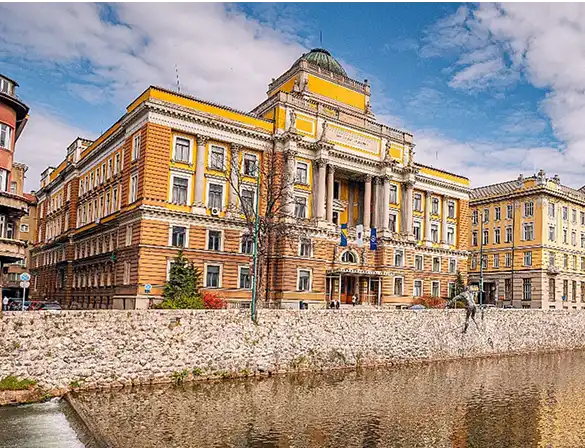
Founded in 1949, the University of Sarajevo brings together approximately 24,000 students, more than 2,600 employees — including over 1,300 academic staff — across 31 faculties, academies and research institutes spanning all major fields of study.
This breadth provides a strong interdisciplinary foundation, together with the human, research and material capacities needed to advance sustainability and climate action.
The University of Sarajevo is one of the first academic institutions in the Western Balkans to establish a dedicated Office for Climate Change and Sustainability, aligned with the European Green Deal and the regional decarbonisation agenda.
This positions the University as a regional hub for sustainability and climate action.
Through this Office, the University:
More Than an Office
A Driver of Change
Through the Sustainability Learning & Impact Platform (SLI), the Office turns knowledge into measurable and lasting impact.
Through accredited certification programmes, targeted training and strategic partnerships, SLI supports the integration of sustainability into education, research and institutional development.
“We don’t just teach sustainability — we live it, apply it and empower others to lead it.”
Stay Connected


Follow our work, expert insights, projects, training programmes and open calls.




Copyright © 2026 Centar za istraživanje i razvoj | UNSA | Powered by Centar za istraživanje i razvoj | UNSA